





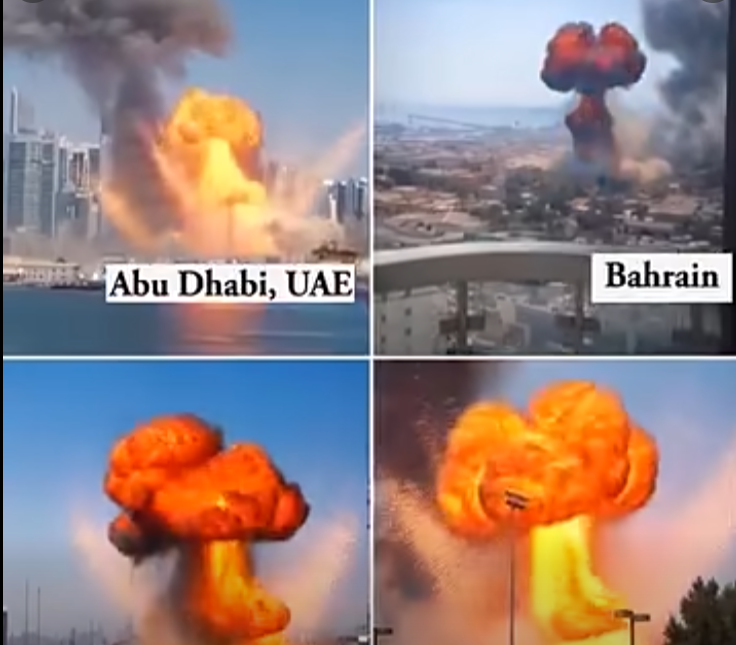
A highly sensational and widely shared viral explosion composite video has taken social media platforms by storm, generating immediate concern and intense debate among global audiences. The short video clip presents a four-panel split-screen that purports to show simultaneous, massive explosions ripping through major cities across four different Middle Eastern nations. Each quadrant of the screen contains dramatic footage of a violent blast accompanied by prominent text labels identifying the locations as Abu Dhabi in the United Arab Emirates, Bahrain, Qatar, and Saudi Arabia. The shocking imagery of bright orange fireballs and towering mushroom clouds creates a profound sense of an coordinated, region-wide military strike or an unprecedented industrial catastrophe. Above the media player, a bold headline formatted as “BREAKING NEWS… 4 countries join forces to atta…see more” leverages extreme urgency to compel users to click and share. This psychological engagement loop captures human curiosity by presenting a terrifying vision of geopolitical warfare breaking out in real-time. By synthesizing distinct pieces of catastrophic footage into a single, synchronized timeline, the content effectively creates a powerful piece of alternative media designed to manipulate social algorithms. Understanding the visual composition and the context surrounding this media artifact provides crucial insights into how digital misinformation operates during periods of heightened global tension.
Detailed Visual Breakdown of the Multi-Country Blast Footage
The visual impact of this online campaign relies entirely on the synchronized presentation of four high-energy combustion events that dominate the screen. In the top-left quadrant, captioned “Abu Dhabi, UAE,” a massive explosion erupts along a modern coastal skyline filled with gleaming skyscrapers, sending a dense plume of dark grey smoke rising rapidly into the clear blue sky. The camera captures the blast from a distance across the water, illustrating how the violent concussion instantly masks the lower sections of the urban waterfront. Meanwhile, the top-right panel labeled “Bahrain” depicts an equally terrifying explosion filmed from an elevated residential balcony overlooking a sprawling metropolis. The blast in this segment forms a distinct mushroom-shaped cloud, with bright orange fire tearing through the center of a dense column of dark, carbonaceous smoke. The low-lying city landscape below is completely dwarfed by the scale of the atmospheric disturbance, highlighting the severe visual weight of the incident. Each frame in the upper half of the composite is calibrated to suggest that major financial and civic centers are actively under siege from a high-yield destructive force.
Analyzing the Intense Imagery of Fireballs and Mushroom Clouds
The lower half of the split-screen continues to assault the viewer’s senses with highly volatile visual elements that emphasize absolute structural devastation. In the bottom-left panel, designated as “Qatar,” a close-up perspective showcases a violent, rolling fireball blooming aggressively above a dense urban residential neighborhood. The intense thermal energy released by the flash causes the bright orange core to expand outward before transitioning into a churning vortex of black soot. The proximity of the camera to the base of the explosion provides an unfiltered look at how localized infrastructure is immediately consumed by high-temperature flames. Adjacent to this scene, the bottom-right quadrant representing “Saudi Arabia” captures a secondary explosion characterized by a dramatic vertical pillar of fire. Bright white and yellow flashes erupt violently from the core of the blaze, suggesting the involvement of highly pressurized fuel or industrial storage containers. A steel lattice tower or stadium light fixture stands remarkably close to the inferno, highlighting the immediate threat posed to vital civic utility networks. The combined effect of these four rolling disasters creates a chaotic, deeply unsettling visual mosaic that completely obscures any sense of calm or normalcy.
Deconstructing the Mechanics of Online Clickbait and Misinformation
Beyond the raw violence of the imagery, the textual framework accompanying the post plays a fundamental role in executing a highly successful digital engagement strategy. The deliberate use of an open-ended, alarmist headline like breaking news global conflict rumor is a classic tactical maneuver utilized by unauthorized media channels to maximize click-through rates. By omitting the conclusion of the sentence and hiding the full context behind a “see more” link, the post actively exploits human curiosity and anxiety. As millions of users engage with the post out of fear or frustration, the hosting platform’s automated systems interpret the high volume of traffic as a signal of valuable content. Consequently, the algorithm begins actively promoting the video to a wider audience, creating an organic chain reaction of unverified visibility across international borders. This calculated manipulation of public emotion underscores the systemic vulnerabilities present within modern algorithmic content delivery networks. It illustrates how easily re-contextualized or digitally manipulated disaster footage can be repurposed to simulate a global crisis that does not exist in reality.
The Critical Importance of Digital Media Literacy and Fact-Checking
The rapid global dissemination of this dramatic composite footage underscores the absolute necessity for rigorous social media media literacy in the contemporary information age. When presented with shocking, multi-panel visual content depicting international warfare, the natural human instinct is to immediately react with panic rather than objective verification. Independent fact-checking organizations frequently discover that videos of this nature are created by compiling completely unrelated historical footage of industrial accidents, controlled demolitions, or past conflict zones. It is vital for modern internet consumers to cross-reference alarming visual claims with trusted, mainstream international journalistic networks before accepting them as absolute truth. True digital resilience requires users to look past sensationalized headlines and actively analyze the source, timeline, and authenticity of the media they consume. The ease with which video clips can be compiled, labeled, and globally distributed means that misinformation can travel around the world before the facts can be established. Ultimately, analyzing the anatomy of this specific viral post reveals that the true product being manufactured is not authentic news, but rather human attention and emotional reactivity.