




The flashlight beam in his hand trembled, cutting through the heavy, suffocating dust of the attic. For three years, they had lived with the low, rhythmic hum vibrating through the ceiling boards. Every pest control company they called had given them the same bizarre, abrupt refusal: “We don’t service that area anymore.” Or worse, they would show up, take one look at the attic hatch, turn pale, and leave without charging a dime.
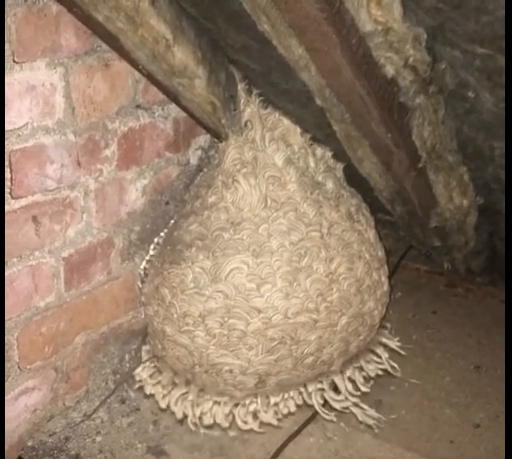
James had assumed it was just a massive, aggressive hornets’ nest. But as he stepped past his crying son and shone the light into the deepest, darkest recess of the eaves, he realized why the experts had fled.
The structure was enormous, spanning nearly six feet across, clinging to the rafters like a bloated, gray tumor. But it wasn’t made of chewed wood pulp and saliva.
As James forced himself closer, the dull, erratic clicking from inside the structure grew louder. He wiped a layer of grime off his glasses and focused the beam on a jagged, football-sized tear near the base of the nest—the opening Liam had been staring into.
There were no insects.
Inside the hollow shell, suspended by thick, calcified tendrils, was an intricate, pulsing mass of dark metal, glass, and what looked like decaying leather. Strands of copper wiring, green with age, pulsed with a faint, rhythmic bioluminescence. But it was the center of the mass that made James’s breath catch in his throat.
Encased in a glass-like amber cylinder was a row of faded, handwritten labels, and beneath them, a series of small, perfectly preserved photographs.
James took a step back, his boot cracking against a loose floorboard. He knew those faces.
The first photograph was of the home’s previous owner, a reclusive radio engineer who had vanished mysteriously in the late 1990s. The second was a local mail carrier who had gone missing five years ago. And the third, freshest photograph, taken from a candid, terrifyingly close angle, was of Liam.
The “stings” they had suffered over the years hadn’t been from wasps. They were the marks of tiny, mechanical needles. The hum wasn’t the buzzing of a hive; it was the sound of data being compiled, a low-frequency broadcast transmitting their lives to somewhere deep underground.
From inside the dark tear of the hive, a small, silver filament—tipped with a lens that looked horribly like a human iris—slowly extended, clicking as it locked onto James’s terrified face.
What do you think James should do next: try to destroy the mechanism immediately, or grab Liam and flee the house entirely?