





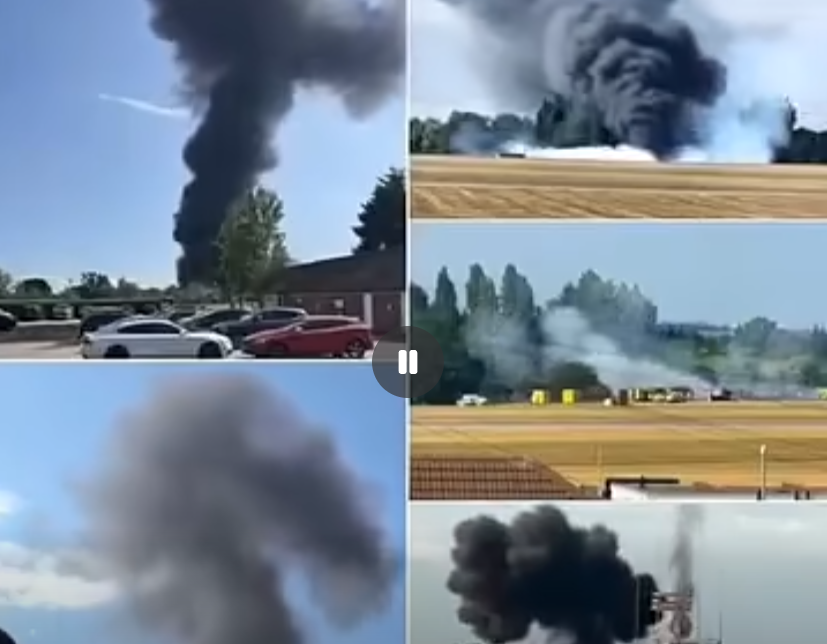
A highly controversial and intensely debated breaking celebrity news rumor has taken social media by storm, capturing the undivided attention of millions of internet users across multiple mainstream digital platforms. The dramatic footage features a multi-panel video grid that documents a severe industrial accident or aviation incident, which has unfortunately been re-contextualized by sensationalist channels online. In the opening moments of the video compilation, a quiet, peaceful afternoon is instantly shattered by a sudden and severe explosion that can be seen from miles away. The visual panels reveal different perspectives of a massive eruption of dark, billowing smoke rising aggressively into clear blue skies. On one side of the screen, a towering column of thick black smoke dominates the horizon, rising dramatically above a parking lot filled with various modern vehicles and low-rise buildings. The sheer scale of the smoke plume indicates that a significant combustion event or a high-energy blast has just occurred within the vicinity of a transport or aviation hub. Onlookers and residents from surrounding neighborhoods are left stunned as they witness the dark cloud expand outwards and mask the bright daylight. This specific video has sparked an absolute frenzy of online discussions, unfortunately becoming a vehicle for clickbait headlines regarding the tragic passing of prominent public figures.
Detailed Breakdown of the Tragic Aviation Disaster and Smoke Plume
The physical characteristics of the catastrophic airfield crash are documented through several distinct camera angles, providing a comprehensive view of the unfolding disaster. As the video cuts to a closer perspective of the open field, the true origin of the intense fire becomes increasingly apparent to viewers. A violent mixture of thick white steam and dark carbonaceous smoke erupts continuously from a specific point on the dry, grassy ground. The massive volume of smoke indicates the involvement of highly volatile compounds, likely aviation fuel or specialized industrial machinery. The smoke column does not merely dissipate but instead forms a dense, churning vortex that rises steadily into the upper atmosphere. The turbulent motion within the cloud suggests that an active, high-temperature fire is still feeding the disaster from below, complicating initial containment efforts. The surrounding landscape, consisting of wide-open golden fields, appears exceptionally dry, which introduces a major risk of secondary fires breaking out across the perimeter. This haunting footage clearly captures the terrifying speed at which an initial point-source explosion can consume the surrounding air and completely alter local visibility.
Rapid Emergency Response and Perimeter Management
Further segments of the video reveal a coordinated but high-stakes response to the airfield accident smoke as emergency vehicles begin arriving at the secure zone. A bright yellow fire truck and several support vehicles are seen stationed along the edge of the paved runway, their flashing emergency lights reflecting against the dry grass. The rescue personnel appear to be establishing a strict safety perimeter around the active blast zone to protect secondary structures and non-essential personnel. The distance maintained by the emergency crews suggests that the threat of secondary explosions or toxic gas inhalation remains exceptionally high during the initial phase. The open airfield environment complicates firefighting efforts, as shifting winds can easily redirect the massive smoke cloud toward nearby residential areas or active public roads. Thick layers of low-lying smoke can be observed drifting lazily across the horizon, creating a hazy barrier that completely obscures the background trees and structures. The presence of specialized utility trucks indicates that technicians are likely working to isolate fuel lines or electrical grids that could further fuel the inferno.
Close-up Views of the Fireball and Structural Threats
The gravity of this industrial explosion footage is further emphasized by a dramatic close-up sequence showing the actual flame front. For a brief moment, a brilliant orange fireball erupts violently from the base of the main smoke column, indicating a sudden re-ignition or a breach of a pressurized fuel container. The intense thermal energy released by this flash creates a rapid expansion of the dark cloud, pushing it even higher into the sky. In the foreground of this specific angle, a steel lattice tower equipped with monitoring equipment or communication antennas stands remarkably close to the danger zone. The dark smoke curls around the metallic framework of the tower, illustrating the immediate threat posed to vital airfield infrastructure and local communications. This close proximity raises serious concerns regarding the long-term structural integrity of the surrounding facility and its specialized technical equipment. The contrast between the bright, destructive flames and the cold, gray industrial equipment creates a visually striking but deeply unsettling image that underscores the severity of the accident.
Deconstructing the Mechanics of Online Misinformation and Clickbait
Beyond the raw violence of the imagery, the textual framework accompanying the post plays a fundamental role in executing a highly successful digital engagement strategy. The deliberate use of an open-ended, alarmist headline like “BREAKING NEWS!! Sad news just confirmed the passing of…” is a classic tactical maneuver utilized by alternative media channels to maximize click-through rates. By omitting the actual name of the individual and hiding the full context behind a “see more” link, the post actively exploits human curiosity and anxiety. As millions of users engage with the post out of fear, sadness, or curiosity, the hosting platform’s automated systems interpret the high volume of traffic as a signal of valuable content. Consequently, the algorithm begins actively promoting the video to a wider audience, creating an organic chain reaction of unverified visibility across international borders. This calculated manipulation of public emotion underscores the systemic vulnerabilities present within modern algorithmic content delivery networks, illustrating how easily re-contextualized disaster footage can be repurposed to simulate a celebrity tragedy.
The Long-Term Impact of Manufactured Crises on Public Perception
The proliferation of heavily manipulated media campaigns like the one analyzed here carries significant long-term implications for general public discourse and media literacy. When digital platforms are flooded with alarming, unverified imagery paired with urgent news headlines, the boundaries of authentic journalism become increasingly blurred for the average consumer. Over time, constant exposure to manufactured crises can induce a state of digital fatigue, leading to widespread cynicism or desensitization among online audiences. Furthermore, the deliberate targeting of human emotions through fake death announcements erodes overall trust in digital media networks and independent content creators. As advanced digital editing and compilation tools become more accessible to the public, the generation of highly convincing, fictional disaster scenarios will only continue to accelerate. This reality underscores the absolute necessity for rigorous fact-checking, proactive digital education, and critical thinking when consuming content online. Ultimately, analyzing the anatomy of this specific social media post reveals that the true product being manufactured is not authentic information, but rather human attention and emotional reactivity.